

Distance from the ball
Arm hang check
Standing too far from or too close to the ball
Let your own arm decide how far you stand from the ball, instead of a fixed measurement in centimetres.
Recognise this?
- Too close: strikes out of the heel of the club, all the way to the shank, with the ball shooting hard to the right.
- Your weight drifts back into your heels and you have to push your hands away to make room; sometimes your hands slide apart on the grip.
- Less distance than you are used to, without swinging any softer.
- Too far: toe strikes that feel short and dead, and thin shots. You have to reach for the ball and your weight falls onto your toes.
- Either way: the strike point on the face moves around from shot to shot.
Why it happens
Where your hands sit in space relative to the ball decides where on the face you strike it. Bring the middle of your hands closer to the ball and the pattern shifts towards heel and fat strikes; take the hands further away and it shifts towards toe and thin strikes. Your address position counts in that, because it decides where you start from. Distance to the ball also changes your whole posture: in a study of eleven professionals, moving closer or further away changed fourteen of the twenty-one address variables. Closer extends the torso, hip, knee and ankle, brings the hands some 3 to 4 cm higher, increases the lie angle, shifts pressure to the heels, lowers clubhead speed and makes the attack angle less downward; further away does exactly the opposite, with pressure on the toes and a higher clubhead speed. That is why knee flex and ball distance go together: too much knee flex puts too much pressure through the heels and produces shanks, the same outcome as standing too close to the ball. There is no universal distance -- arm length, back length and how far back your hips sit all play a part, and a fixed measurement in centimetres ignores those differences.
What the drill fixes
A freely hanging arm is a measurement that scales with your own body: where your relaxed hand comes out is where the grip belongs. Reaching for it means too far; pulling the hand in, or splitting your hands on the grip, means too close.
What you need
- One club; you do not need a ball for the first steps
easy
How to do it
Step 1: Take your normal address position
Set up with the club behind the ball, exactly as you would on the course.
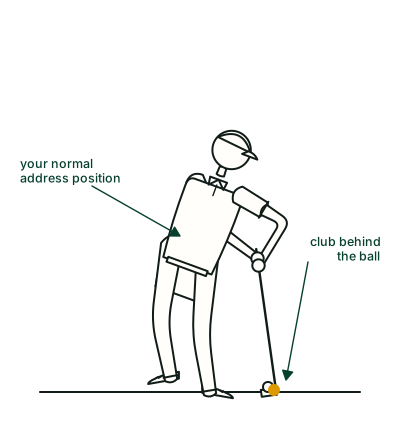
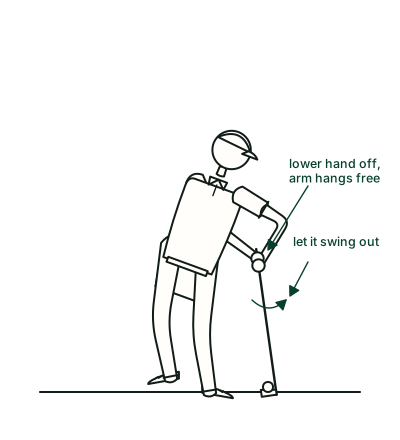
Step 2: Let your lower arm hang
Take your lower hand off the grip and let that arm hang completely loose alongside your body. Let it swing freely back and forth a few times until all the tension is gone.
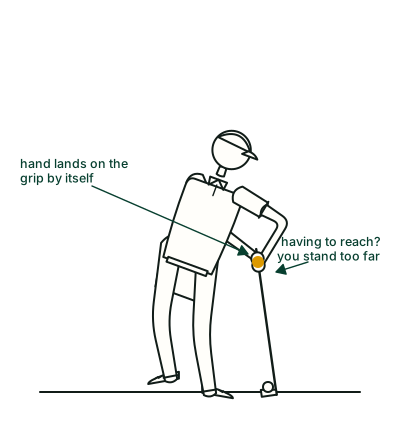
Step 3: The check: does your hand come out on its own?
Let the arm come to rest and bring it back to the club. If your distance is right, your hand lands on the grip by itself. If you have to reach for it, you are standing too far away. If you have to pull your hand in, or split your hands on the grip, you are standing too close.
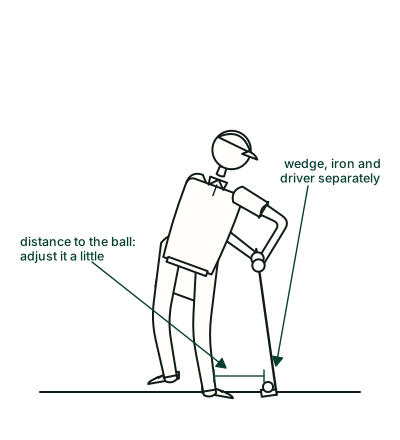
Step 4: Adjust, and do it per club
Move your feet a little towards or away from the ball and repeat, until your hand lands on the grip by itself. Do this separately for your wedge, your mid iron and your driver, because the club length differs.
How often
8 checks per club, 3 clubs, then 5 normal shots per club
Eight is enough to automate the check itself; the shots that follow are the feedback, because the strike point on the face is the only real outcome measure for this fault.
Sources
- Arm Hang: Set Up Distance From The Ball (Tyler Ferrell, Golf Smart Academy)
- The Real Causes Of A Shank (Heel) Or Toe Shot In Golf (Adam Young)
- Kim e.a. (2018), Biomechanical Effects of Ball Position on Address Position Variables of Elite Golfers, Journal of Sports Science and Medicine 17(4):589-598
- The Proper Golf Stance (Will Shaw, PhD, PGA Pro, Golf Insider)
- How Far To Stand From The Golf Ball (Alex Elliott, Golf Monthly Top 50 Coach)
Is this your fault to fix?
Caddium measures it in your own swing video — your first analysis is free.
Start free