

Shoulder plane
Club across the chest
Your shoulders turn too flat
Let your shoulders turn on the plane that belongs to your spine angle, instead of too horizontally around your body.
Recognise this?
- At the top your swing feels as though it goes around your body instead of up.
- Your misses are far apart: topped balls and balls that curve away to the right, but also thin shots and balls that dive left.
- In the downswing you always have to save something with your hands to get the clubface square.
Why it happens
Your shoulders turn on a more horizontal plane than the spine angle you set at address; ideally they turn perpendicular to that axis. That takes the club out of position in the backswing and creates a plane shift in the downswing, which you have to make up for with your body or your hands to square the face — with loss of power and inconsistent contact as a result. The physical causes are too little separation between torso and pelvis, too little torso stability to hold your forward bend, and limited hip and shoulder mobility. The fault has two faces: if your shoulders turn too parallel to the ground, the club comes in very steeply in the downswing (balls that curve away to the right, topped balls); if you swing too much around your body, you get thin shots, balls that dive left and pushes. The flattening can arise in the backswing as well as in the downswing, so first establish when it happens for you.
What the drill fixes
The club on your chest makes the direction of your shoulder plane visible: the lead end points at the ball as long as your shoulders turn perpendicular to your spine, and drifts off towards the horizon as soon as they flatten out.
What you need
- A club or alignment stick
- A ball on the ground as a reference point
- A mirror or a phone, from the side
medium
How to do it
Step 1: Place the club across your chest
Hold a club across your chest with both ends and take your normal golf posture, with a ball on the ground in front of you.
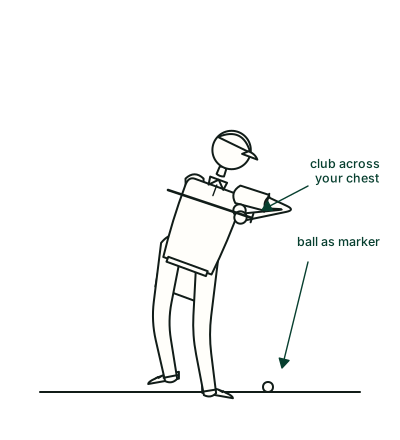
Step 2: Turn to the top and see where the club points
Turn to your backswing position. Marker: the end on your lead side points at the ball, not far above the ball into the horizon.
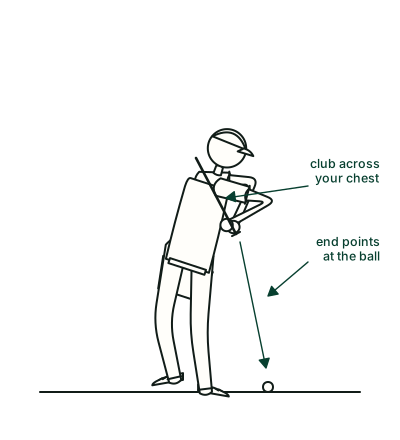
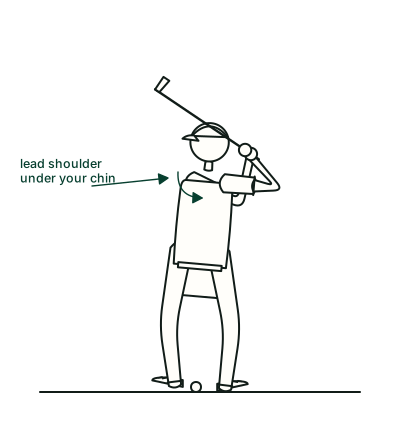
Step 3: Lead shoulder down and under your chin
At the same time feel your lead shoulder working down and under your chin, instead of only going around. Then repeat it with a club in your hands and hit half shots with the same feeling.
How often
2 sets of 10 practice swings with the club across your chest, then 10 half shots.
The check is purely visual. Repetitions without a mirror or camera have no marker and therefore achieve nothing.
Sources
- Flat Shoulder Plane | Swing Characteristics | TPI
- What is the shoulder plane in your golf swing and why does it matter?, Nathalie Filler, GOLF.com
Is this your fault to fix?
Caddium measures it in your own swing video — your first analysis is free.
Start free