

Spine angle
Turning around a fixed axis
You come out of your posture during the swing
Turn your swing around the same angles you set at address, instead of changing them along the way.
Recognise this?
- On video you stand more upright in the backswing than at address: you grow out of your posture.
- One ball flies far to the right and the next dives to the left.
- Inconsistent contact: one shot thin, the next fat.
- In the follow-through you are looking for your balance instead of having it.
Why it happens
Any meaningful change in the angles from your set-up counts as a loss of spine angle, and that disturbs timing, balance and rhythm. There are usually physical limits behind it: you cannot hinge through your hips deeply enough, your torso and pelvis cannot turn far enough independently of each other because of a stiff spine or short lats, your torso is too weak, or your hips and shoulders are too restricted in movement. In the backswing four practical causes join them: too much knee flex without a hip hinge, which leaves you no room to turn into; the back hip sliding sideways away; the arms lifting away from the torso; and a lead wrist that bends too early, after which you unconsciously stand up to make speed anyway.
What the drill fixes
You get two checkpoints that do not depend on feel: in the mirror you see whether the angle of your shoulder line to the ground stays the same, and the stick beside your back hip tells you straight away whether that hip slides away instead of turning.
What you need
- A mirror or a phone on a tripod, from the side
- An alignment stick
- A club
medium
How to do it
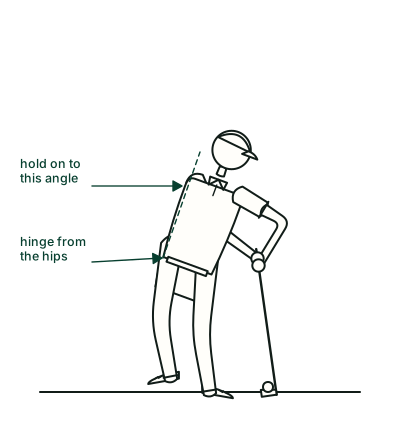
Step 1: Set up in your posture
Hinge from your hips until your fingertips are just above your knees, with a little knee flex and your arms loose. Remember the angle of your back.
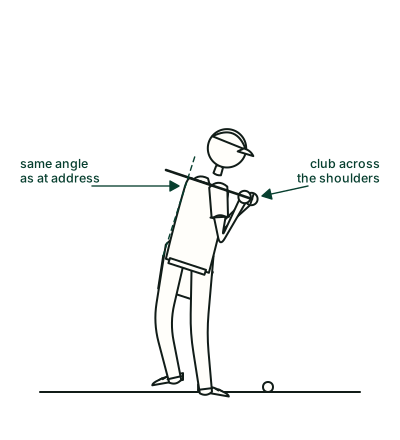
Step 2: Turn with a club across your shoulders
Lay a club across your shoulders and turn slowly to the top. Checkpoint: the angle of your shoulder line to the ground stays the same as it was at address.
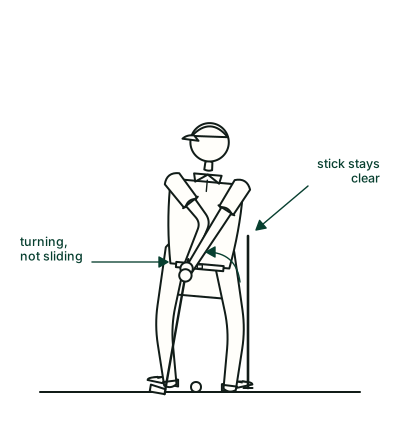
Step 3: Stick beside your back hip
Put the alignment stick just outside your back hip and repeat the turn without touching the stick. Your back hip turns backwards, it does not slide outwards.
How often
10 slow practice swings with the club across your shoulders, then 2 sets of 10 shots with the stick.
Do the mirror check before you start hitting: the source links holding your posture directly to your set-up and to a centred hip turn. Then build up from half to full swings with a ball, and check on video after each set whether your spine angle is still there.
Safety
Do not force a deeper hip hinge than your hamstrings allow; that loads your lower back.
Sources
- Loss of Posture | Swing Characteristics | TPI
- How to Maintain Posture in the Golf Swing: Tips & 5 Fixes, Britt Olizarowicz (HackMotion)
Is this your fault to fix?
Caddium measures it in your own swing video — your first analysis is free.
Start free