

Grip
Rebuilding the grip to neutral
Grip too strong
Rebuild your grip from hanging arms to a neutral position, so that the clubface no longer closes.
Recognise this?
- The ball starts roughly on line and then curves sharply away to the left.
- In its worst form: a low ball that dives left immediately and ends up in trouble.
- At address you see a lot of knuckles on your top hand, and your bottom hand feels as if it sits largely under the club.
- You feel you cannot swing the club through freely; the strike feels pinched instead of extended.
Why it happens
With the classic hook grip the top hand sits too far to the right on the club and the bottom hand sits too much underneath it. That hand position lets the clubface rotate too far through the impact zone, so it arrives closed and the ball curls to the left. Jack Nicklaus reaches the same conclusion: too strong a grip closes the clubface at the moment of impact and produces low balls that dive left quickly, and he adds that a wrong grip stops you releasing fully and extending your arms fully at impact. The grip therefore has to be right first: dodging the hook by aiming further right only strengthens the pattern, and other drills are pointless until the hands are correctly placed.
What the drill fixes
You start from the position your arms take on by themselves when they hang relaxed, and place your hands there without still rolling them to the right; the knuckle count in the mirror is the check that it really has become neutral.
What you need
- A mid-iron
- A mirror or a phone on a tripod
- Enough room to take your address position
easy in movement, medium to sustain: the feeling changes a lot
How to do it
Step 1: Hands together, without rotating
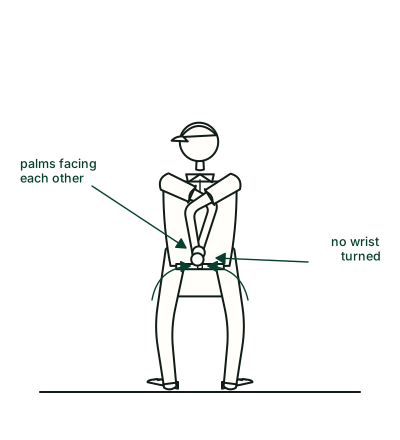
Stand upright without a club, let both arms hang relaxed alongside your body and then bring them together in front of you without rotating them. That is how your hands will close around the club. Checkpoint: your palms face each other, and neither wrist is turned inwards or outwards.
Step 2: Top hand first, then the bottom hand
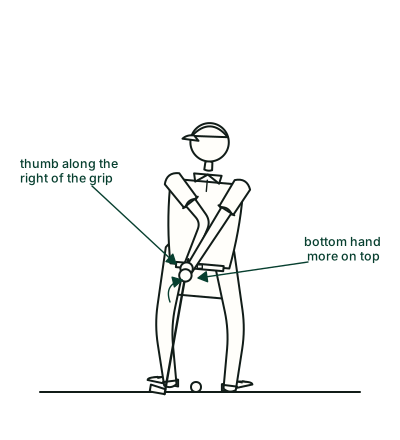
From that position, place your top hand on the club first, then the bottom hand, without still rolling the hands to the right. The checkpoint for neutral: the thumb runs along the right side of the grip and the bottom hand sits a little more on top of the club instead of underneath it.
Step 3: Count your knuckles
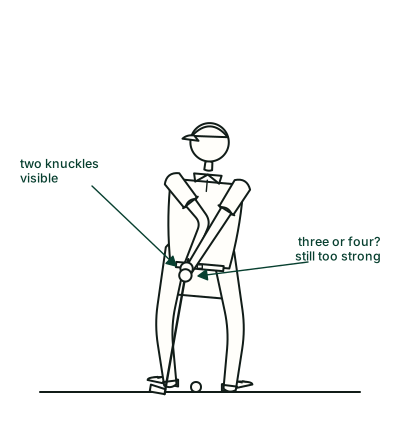
Check in the mirror how many knuckles you can see. Neutral is about two knuckles of each hand at address. If you see three or four on your top hand, you are still in the strong position.
Step 4: Ten half shots, rebuilt every time
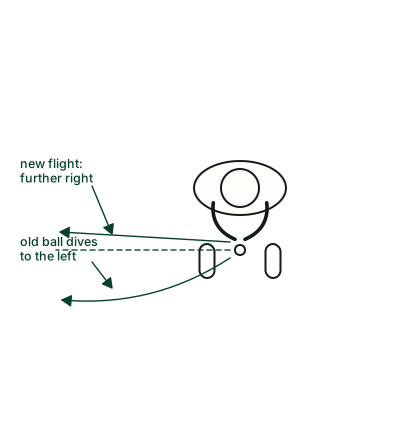
Hit ten shots with a half-length swing, letting go of the grip completely before every shot and rebuilding it as in steps 1 to 3. Checkpoint: the ball should curl less far to the left. If it still dives hard left, check the knuckles again before you change anything in your swing.
How often
3 × 10 shots, letting go of the grip completely and placing it again between every shot
A corrected grip feels unnatural at first and only becomes second nature after a lot of work, so the number of shots matters less than the number of times you rebuild the new grip. The numbers are a practical translation; the sources give no dosage protocol of their own.
Sources
- How To Fix A Hook In Golf: Causes And Cures (Golf Monthly, PGA-pro Dan Grieve)
- Jack Nicklaus explains how the wrong grip is hurting your game, and how to fix it: Flashback Jack (Golf.com)
- Weak Golf Grip: What Is It And How To Fix It (Golf Monthly, PGA-pro Ben Emerson)
Is this your fault to fix?
Caddium measures it in your own swing video — your first analysis is free.
Start free