

Swing path
Headcover outside the ball
Club comes from outside to inside into the ball
Let the club come at the ball from the inside from the top, instead of throwing your shoulders over it.
Recognise this?
- Your ball starts left and then curves hard away to the right.
- Or it sets off straight left, sometimes with a dive to the left as well.
- It feels as though you throw your shoulders over the ball and your arms shoot at it straight from the top.
- Your divots are deep and steep and point left of your target.
Why it happens
According to TPI this fault starts in the upper body: it does too much at the start of the downswing, which takes the club outside the plane and brings it in from outside to inside. The upper body taking over happens because the lower body cannot start the downswing: too little weight shift in the transition, limited hip mobility and weak core and glute muscles. Nick Clearwater of GOLFTEC describes the same movement as throwing the club straight down; whether you get a slice or a diving ball to the left from it depends only on how the clubface is set. HackMotion adds three drivers: a steep backswing, a lead wrist too far bent at the top, and shoulders that open up too early.
What the drill fixes
The obstacle gives feedback that cannot be argued with: if the club comes from outside to inside, you hit it. If the club stays inside, it stays put.
What you need
- A headcover, pool noodle or empty water bottle
- An iron
easy
How to do it
Step 1: Put the obstacle down
Put the headcover just outside the target line, about a hand's width from the ball on your back side. A path from outside to inside will then inevitably hit it.
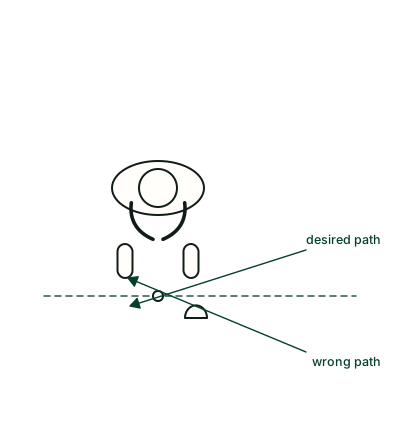
Step 2: Let the club drop to the inside
Make a half swing and let the club drop under and inside the obstacle in the downswing. The marker is that you do not hit the obstacle.
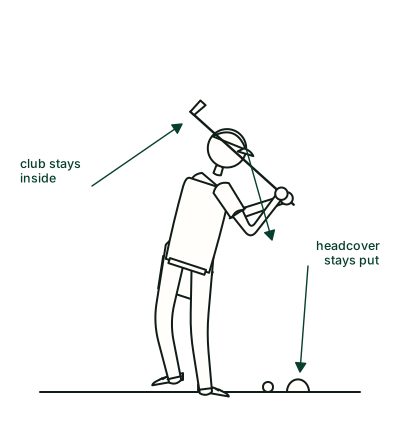
Step 3: Through the ball from the inside
Build up to full swings and let the club come through the ball from the inside. If you hit the obstacle, go back to half swings.
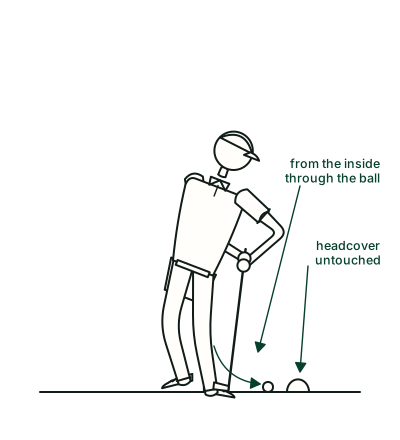
How often
3 sets of 8 balls
Between each set, 3 practice swings to bring the feeling back. The sets stay short because the feedback is binary: hit or no hit. After a miss you want to correct rather than keep swinging.
Safety
Use something soft: a headcover, pool noodle or empty bottle. A hard object right beside the ball can bounce back on a miss and load your wrist.
Sources
- Over the Top | Swing Characteristics | TPI
- Coming over the top? These 2 foolproof drills will instantly redirect your swing, Luke Kerr-Dineen met Nick Clearwater, GOLF.com
- 7 Best Drills to Help You Stop Coming Over the Top (HackMotion)
Is this your fault to fix?
Caddium measures it in your own swing video — your first analysis is free.
Start free