

Alignment
Heel line and shoulder check
Incorrect alignment of feet and shoulders
Aim the clubface first and only then set your body parallel to the target line, and check that with a stick on your heels.
Recognise this?
- You strike the ball well, it flies nicely — and it still finishes consistently left or right of the flag.
- You keep missing to the same side, with different clubs too.
- Short shots miss proportionally worse than long ones: from 70 metres you finish further off the flag than you would expect.
- On the course it goes worse than on the driving range, where everything lies neatly in a row.
- You have taught yourself a trick to get the ball back on line, and that trick does not always work.
Why it happens
Golf is one of the few games in which you stand beside your target object instead of behind it, and that makes your perception of the target line systematically distorted. In Rick Martino's figures, high handicappers made about twice as much aiming error as professionals, the error on the course was greater than on the range (clubface error from 3.75 to 4.35 yards) and the error almost doubled from 190 yards to 70 yards. On top of that comes where you aim your body: under the railway-track principle the clubface aims at the target and your foot line lies parallel to it, so for a right-handed player it points slightly left of the target. If you do aim your body at the target, you are in effect aligned to the right. Aimed left you cut across the ball, aimed right you push it away. The third piece is the order: amateurs set their body first and only then aim the clubface, whereas the face is the object that goes through the ball and so should be aimed first. It does not stand out by itself because your body unconsciously compensates for the crooked position, and that compensation hides the original fault.
What the drill fixes
You no longer aim by feel: you fix the order (face first, body after) and make the body line visible with a stick you can check from outside.
What you need
- One alignment stick, or a club you can lay on the ground
- A second club for the shoulder check
easy
How to do it
Step 1: Pick an intermediate point
Stand behind the ball, look along the target line and pick an intermediate point on that line: a tuft of grass or an old divot a few feet in front of your ball. Over a short distance a line is much easier to check than at a hundred metres.
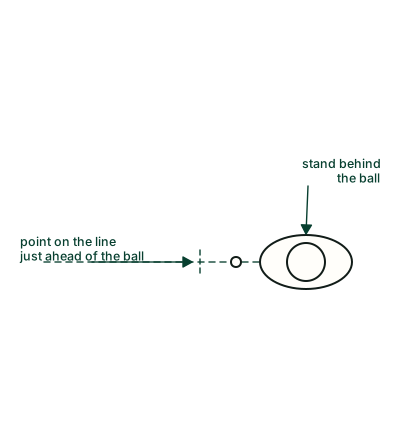
Step 2: Face first, body after
First aim the clubface square to that line, and do that in your address posture, so bent forward — not standing upright and only then bending over. Only then set your feet, knees, hips and shoulders parallel to that line.
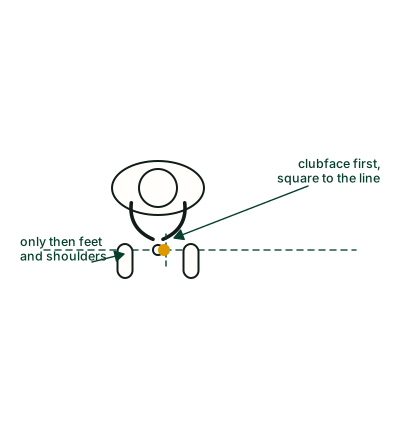
Step 3: Stick on your heels
Lay a stick along your heel line, not your toe line — your feet can be turned out and then they distort the picture. Step back, stand behind the stick and check that it lies parallel to the target line and does not point towards it.
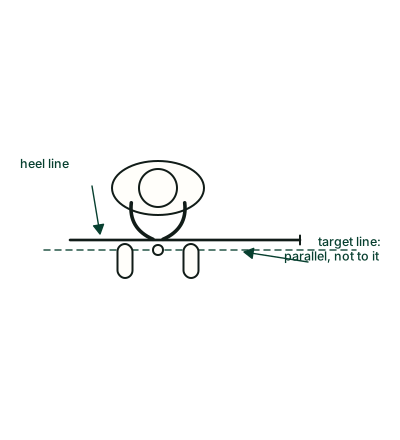
Step 4: Shoulder check
Take your address posture and hold a club by both ends with your arms hanging straight down. The club then points the same way as your shoulders. Compare that direction with the stick on the ground; they should be parallel.
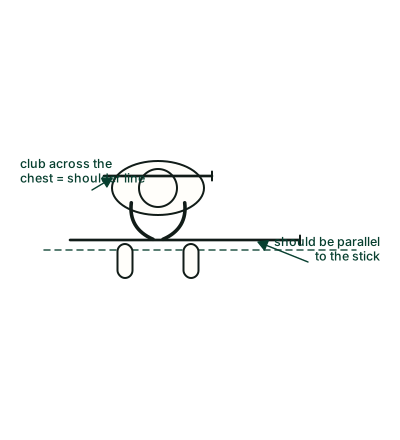
How often
10 set-ups per practice session: 5 without a ball, 5 followed by a shot
Alignment is not a strength exercise but a routine, so what counts is the number of times you run through the order correctly, not the number of balls.
Sources
- Why your aim and alignment are poor (and how you can fix them!) (Rick Martino)
- Struggling with poor aim? This common setup mistake could be the culprit (Teresa Zamboni, LPGA)
- How To Aim In Golf (Zane Scotland, Golf Monthly Top 50 Coach)
- How to Use Alignment Sticks (Matt Saternus, Plugged In Golf)
Is this your fault to fix?
Caddium measures it in your own swing video — your first analysis is free.
Start free