

Tempo
Pause at the top
Rushing the transition
Finish your backswing completely and start the downswing from a standstill, so that the backswing takes about three times as long as the way back down to the ball.
Recognise this?
- You feel that you grab at the ball from the top instead of letting the swing unfold by itself.
- You swing back slowly and deliberately and then throw everything at it in one go.
- The misses alternate without you knowing why: one ball thin, the next to the right, the next fat, and a different length every shot.
- Your practice swing feels smooth, but as soon as there is a ball the tempo goes up.
Why it happens
Good players share a fixed tempo ratio: the backswing lasts about three times as long as the downswing, three to one. John Novosel established that in 2000 with, among others, Tiger Woods, Jack Nicklaus and Gary Player, and Dr. Bob Grober of Yale confirmed it in 2012 with sensors in the club: tour players averaged 3:1 and sat close together, while the tempos of average players went in all directions. Amateurs fall outside that ratio because they deliberately slow their backswing down and then have to force the movement down to make up for it. PGA professional Jack Backhouse names three practical reasons to rush: not finishing the backswing, nerves or eagerness to hit the ball, and not knowing how the sequence in the swing should run. The misses he links to it are thin, slice, shank, fat, loss of power and hanging back on the back foot.
What the drill fixes
The pause at the top pulls the two halves of the swing apart. You can no longer rush through from a half, braked backswing, and you feel that the way down is short compared with the way back: exactly the three-to-one ratio.
What you need
- A 7 iron
- Optionally a metronome or the Tour Tempo app, which plays three tones: start of backswing, start of downswing, moment of impact
medium
How to do it
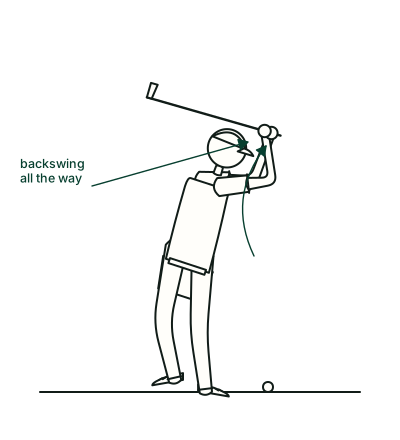
Step 1: Swing your backswing all the way to the top
Make a normal backswing with your 7 iron and deliberately swing through to the top, without slowing down. Checkpoint: the backswing has to be complete. A half, held-back backswing is exactly where the rushing starts.
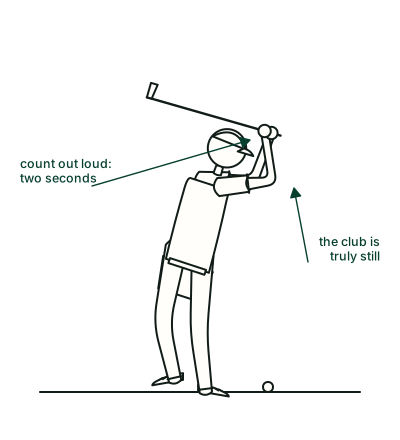
Step 2: Stand still for two seconds
Hold the top position for two seconds and count out loud. Checkpoint: you feel the club come to a stop before you move anything downwards.
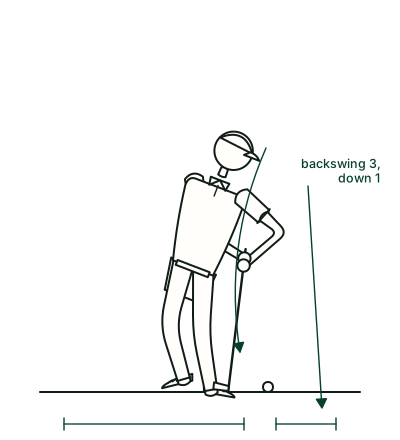
Step 3: Start down from a standstill
Start the downswing from that standstill and hit the ball, without grabbing at it after all. Checkpoint: the way down feels short compared with the backswing. That is the three-to-one ratio you are after.
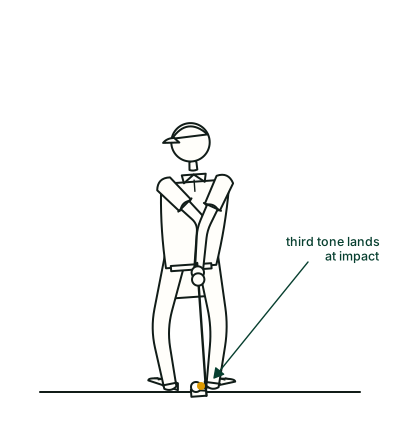
Step 4: Repeat without the pause
Hit the same shot without the pause, but with the same feel for the ratio. If you are working with the app or the metronome: start the backswing on the first tone, start down on the second, hit the ball on the third.
How often
Three times: five shots with the two-second pause, then five shots without the pause
The two-second pause comes from Backhouse. The number of repetitions is a practical choice by the researcher. The pause is an exaggeration you do not use on the course, so you have to keep translating it back to a normal shot; alternating forces that translation.
Safety
Make sure you have clear space around you; you are hitting full swings with an iron here.
Sources
- Swing Tempo: The Cornerstone of a Successful Golfer (Practical-Golf.com, met interviews met John Novosel en Dr. Bob Grober, Yale)
- Stop RUSHING Your Downswing (National Club Golfer, PGA-professional Jack Backhouse)
- Tour Tempo App (Tour Tempo, John Novosel)
Is this your fault to fix?
Caddium measures it in your own swing video — your first analysis is free.
Start free