

Putting
Putting from three distances
Distance control / lag putting
Build a feel for length by switching distance every time, with a tolerance of one tenth of the putt length as your reference point.
Recognise this?
- From long range you consistently come up metres short, or you send the ball racing well past the hole.
- You three-putt regularly, even though the first putt did start on the right line.
- You have no idea how long your backswing needs to be for a given distance; you guess again every time.
- You accelerate or decelerate just before the ball to correct the distance after all.
Why it happens
Dave Pelz names as the cause of weak distance control that players think too much about technique and too little about feel: they are distracted by separate moving parts instead of developing a feel for the movement. Joey Wuertemberger puts the key in a measurable movement instead of guesswork: he calls speed control the most important factor in bringing down your three-putt percentage, and works with a fixed ratio between swing length and distance, about four centimetres of extra movement (back and through) for every three metres of extra putt length, with the throughswing as long as the backswing. Piers Ward works on the same thing with a game format in which not only holing out counts, but also where the ball comes to rest when you miss: inside a narrow zone past the hole is good enough, too short or too long is wrong.
What the drill fixes
Hitting three balls per distance means a fluke does not carry you through the drill, and alternating the distances instead of hitting the same putt ten times forces you to judge by feel every time. That feel is exactly the piece Pelz points to as missing. The tolerance of one tenth of the distance makes the outcome measurable instead of an impression.
What you need
- A practice green with enough length
- Three balls
- Tees or coins to mark the distances with
medium
How to do it
Step 1: Mark three starting points
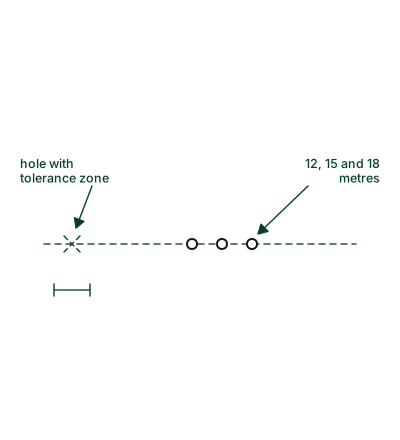
Mark three starting points at roughly 12, 15 and 18 metres from the hole. Your tolerance is always one tenth of the distance: from 12 metres the ball has to come to rest within 1.2 metres, from 15 metres within 1.5 metres, from 18 metres within 1.8 metres.
Step 2: Hit nine putts and write them down
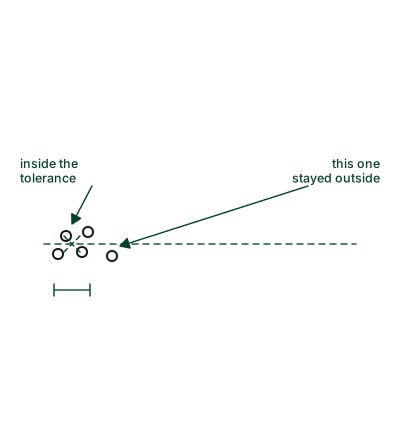
Putt three balls from 12 metres, then three from 18 metres, then three from 15 metres. Note for each ball whether it stayed inside the tolerance.
Step 3: Repeat the series twice more
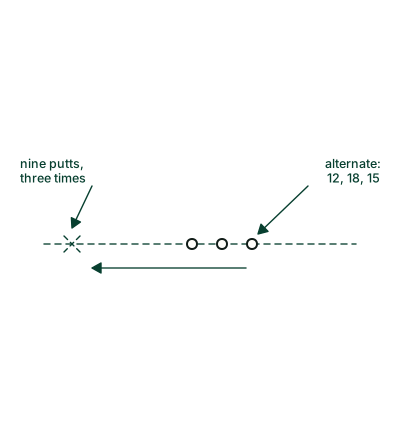
Go through the same series of nine putts twice more, so that you end up at 27 putts. Keep alternating the distances in the order 12, 18, 15 metres.
Step 4: Finish with the test
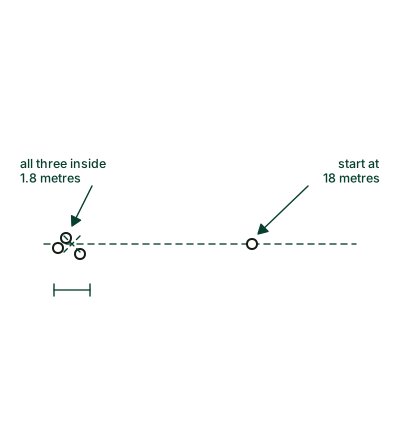
Three balls from 18 metres, and all three have to stay within 1.8 metres. If that does not work, the session is not finished yet.
How often
27 putts (the series of nine, three times) plus a closing test of 3 putts from 18 metres
This is how Pelz sets the drill up himself: 27 putts and a test of 3. Three balls per distance means a fluke does not carry you through the drill; by alternating the distances instead of hitting the same putt ten times, you have to judge by feel every time, and that feel is exactly what Pelz points to as the missing piece.
Sources
- Short-game guru's system to improve distance control - and stop 3-putting (Dave Pelz)
- This speed-control drill will help you cut down on 3-putts (Joey Wuertemberger, GOLF Top 100 Teacher)
- Use the ladder drill to roll putts like a PGA Tour pro (Piers Ward, Me and My Golf)
Is this your fault to fix?
Caddium measures it in your own swing video — your first analysis is free.
Start free