

Torso tilt
Mirror drill
Reverse pivot / reverse spine angle
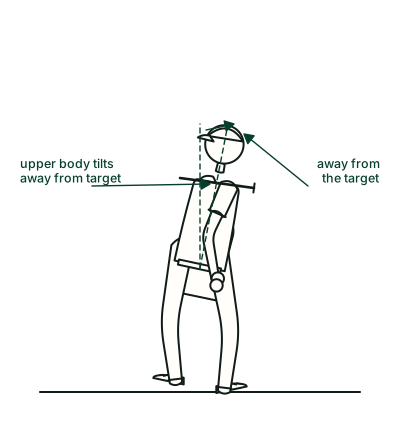
Turn around a fixed axis in the backswing, so that your upper body tilts away from the target at the top instead of towards it.
Recognise this?
- At the top your upper body leans towards the target and your weight is on your front foot.
- At impact you fall backwards instead, with thin or fat shots as a result.
- You have little power despite a big swing.
- Pain or fatigue in your lower back after a round or a bucket of balls.
Why it happens
TPI calls a reverse spine angle the number one cause of lower back complaints in golf: your upper body bends too far backwards towards the target, or sideways, in the backswing. That makes it almost impossible to start the downswing in the right order; your lower body is stuck, your upper body takes over, and that produces path problems and loss of power. TPI points to two injury mechanisms: suppression of the abdominal muscles during the backswing and high loading on the back at impact. The physical causes: too little separation between torso and pelvis, limited internal rotation of the hip and a weak torso. Tony Ruggiero describes the fault on golf.com from the weight distribution: instead of loading onto your back side, your weight moves towards the target in the backswing, and then has to come back in the downswing. He names sideways sliding of the hips as the main cause: you try to get behind the ball by sliding your hips away, which makes your lower body unstable and tilts your upper body towards the target as a counterweight.
What the drill fixes
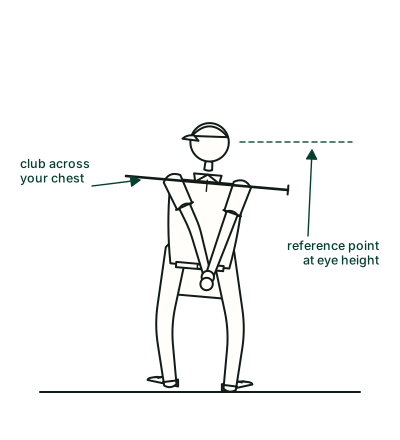
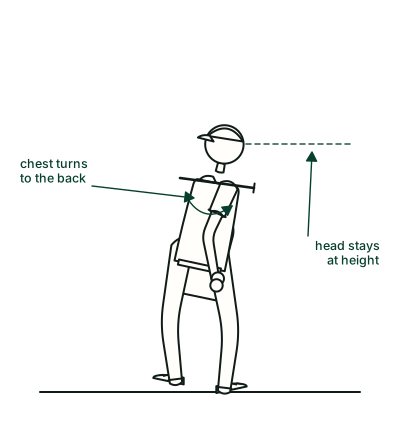
The fixed reference point at eye height shows you whether your head stays in place while your chest turns. If your head sinks away from the reference point, your upper body has started tilting instead of turning.
What you need
- A large mirror or a window
- Something small to stick on the mirror as a reference point, such as a plaster or a sticker
- A club
easy without a ball, medium with a ball
How to do it
Step 1: Stick the reference point at eye height
Stand in your golf posture in front of the mirror with a club across your chest, and stick the sticker on the mirror at the height of your head.
Step 2: Turn your chest to the back
Turn your chest back towards your back leg while your lower body stays quiet and you keep your eyes on the sticker. The checkpoint is that your head does not sink away from the sticker.
Step 3: Check your tilt
Check at the top that your upper body tilts away from the target and not towards it.
Step 4: Repeat with a club in your hands
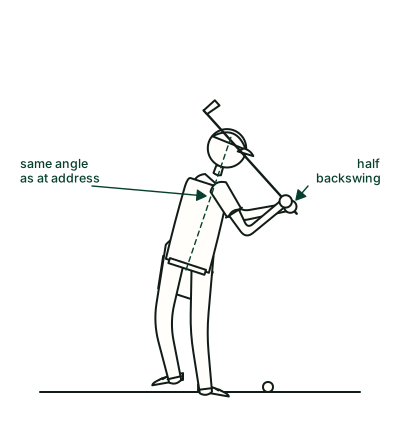
Repeat with a club in your hands and then with half shots. Your spine keeps the same angle as at address.
How often
2 sets of 10 slow turns in front of the mirror, then 10 half shots
Ruggiero emphasises the visual reference point over speed: the aim is that you learn to recognise the right rotation, not that you force it.
Safety
This is the fault with the strongest injury signal in the sources: TPI calls it the number one cause of lower back pain. Do not force the turn and stop if you feel pain in your lower back.
Sources
- Reverse Spine Angle | Swing Characteristics | TPI
- A reverse pivot is a golf-swing killer, Zephyr Melton met Tony Ruggiero, GOLF.com
Is this your fault to fix?
Caddium measures it in your own swing video — your first analysis is free.
Start free