

Posture
Four-step address routine in the mirror
Too much or too little knee flex at address
Build your address posture in a fixed order, so that you tilt from your hips and only unlock your knees.
Recognise this?
- You lose your balance during the swing and wobble forwards and backwards.
- You strike the ball on a different part of the face every time; sometimes a shank comes out.
- Many tops and thin shots without knowing why.
- The feeling that you come up out of the swing at the end and that your hips move towards the ball.
- With too much knee flex: your weight sinks into your heels and you have to push your arms away to make room.
- Standing too upright: your weight sits on your toes and it feels as if you are hanging over the ball.
Why it happens
The confusion is about what bends. The poor posture is standing upright with too much knee flex: you sink through your knees instead of tilting forward from your hips. Too much knee flex actually pulls your chest and arms away from the ground, whereas good posture brings your arms, hands and club closer to the grass. It is also a trade-off: too much knee flex comes at the expense of hip flexion and puts too much pressure through the heels, which gives balance problems and an inconsistent strike point, all the way from shanks on one side to tops and thin shots on the other. The opposite fault is not safer: standing too upright with your weight on your toes is one of the set-up causes of standing up during the swing, because if you do not make room for your hips at address, you have to find that room later anyway. The right posture is bending from the hips and not from the waist, with a neutral spine, the knees unlocked but no further, and the pressure through the middle of the feet.
What the drill fixes
The order itself does the work: by tilting first and only then unlocking the knees, the knee flex can no longer push the hip flexion away, and the mirror shows from the side whether that is really happening.
What you need
- A mirror or a dark window in which you can see yourself from the side, or a phone on a tripod
- A mid-iron
easy
How to do it
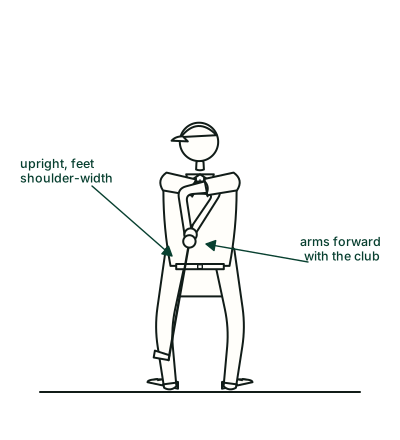
Step 1: Upright, arms forward
Stand upright with your feet about shoulder-width apart. Take hold of the club and stretch your arms forward, at roughly a 45-degree angle.
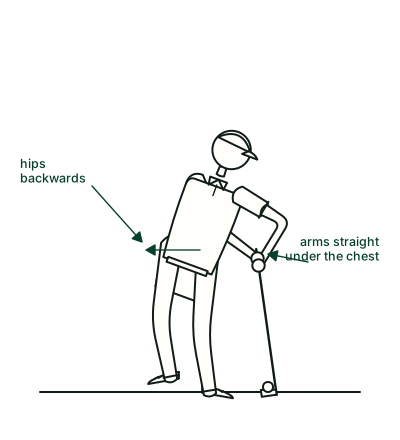
Step 2: Tilt from your hips
Tilt forward from your hips, not from your waist: send your hips backwards and keep your back in its natural position, until your arms hang straight below your chest. It has to feel as if you are bending down towards the ground.
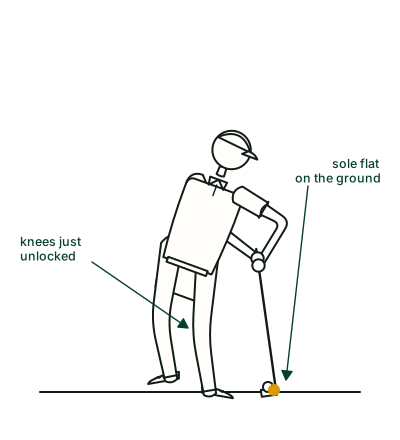
Step 3: Only now unlock your knees
Bend your knees just far enough that they are no longer locked and the sole of the club sits flat on the ground. No further — more knee flex pulls your chest and arms away from the ground again.
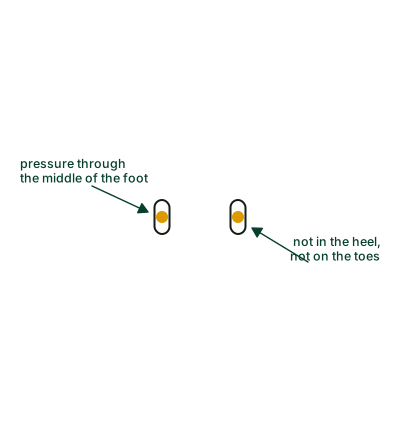
Step 4: Checkpoint: pressure
Feel where your weight sits. It should run through the middle of your feet, not into your heels (too much knee flex) and not onto your toes (too upright). Rock gently forwards and backwards until you find the middle.
How often
2 × 8 address positions per practice session, plus a video from the side once every four weeks
The four-weekly video check of the basics comes from Will Shaw: a posture shifts slowly and you do not notice it by feel, so now and then you need a picture from outside. The numbers of address positions are a practical choice; the sources give no protocol of their own for them.
Safety
Bend from the hips with a neutral back. A wrong address posture brings not only compensations but also injury risk; if you have low back problems, keep the number of repetitions low and stop if it hurts.
Sources
- Use this quick 4-step routine to ensure your posture is perfect at address (Stefanie Shaw)
- The Proper Golf Stance (Will Shaw, PhD, MSc, PGA Pro, Golf Insider)
- Golf Swing Posture: How to Set Up for Power, Balance and Consistency (John Callahan, PGA Professional, Keiser University College of Golf)
Is this your fault to fix?
Caddium measures it in your own swing video — your first analysis is free.
Start free