

Weight shift
Step to the target
Your weight stays on your back foot at impact
Move your weight onto your front foot in the downswing, so that you strike the ball from in front of it instead of hanging back behind it.
Recognise this?
- At impact your weight is still on your back foot and you lean back through the ball.
- Large divots that start behind the ball, and a lot of fat shots.
- Balls that set off high but come up short.
- In the follow-through you fall backwards instead of finishing calmly on your front leg.
Why it happens
What is missing is movement towards the target in the downswing: normally you are about ten centimetres closer to the target at impact than at address, and with this fault you are still on your back foot at that moment. That costs clubhead speed and gives divots that start behind the ball. The physical side: too little mobility in the front hip and ankle, too little stability to put your weight on the front leg, a reverse spine angle, and a lower body that is too weak, so that torso and arms have to supply the power. A release that comes too early works out the same way: the weight stays back, as if you were making a baseball swing without the step into it.
What the drill fixes
The step makes hanging back almost impossible: you hit the ball while your front foot has only just landed, so the weight has to move forward with it.
What you need
- Room to step
- A mid iron
- Optionally a ball on a tee
medium
How to do it
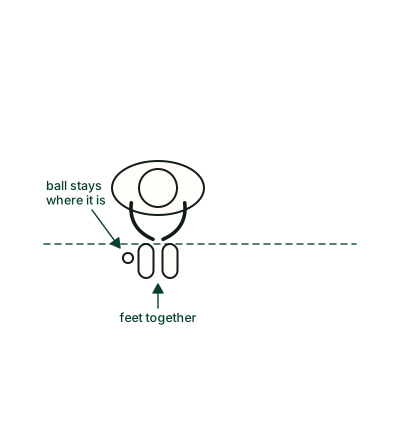
Step 1: Put your feet together
Set up at the ball and then put your front foot next to your back foot, so that you stand narrow. The ball stays in its normal position.
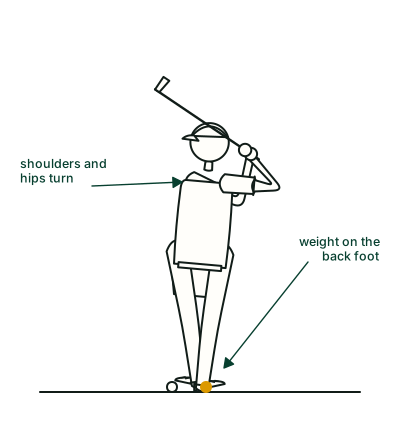
Step 2: Turn and load onto your back foot
Start the backswing by turning your shoulders and hips. Your weight loads onto your back leg by itself.
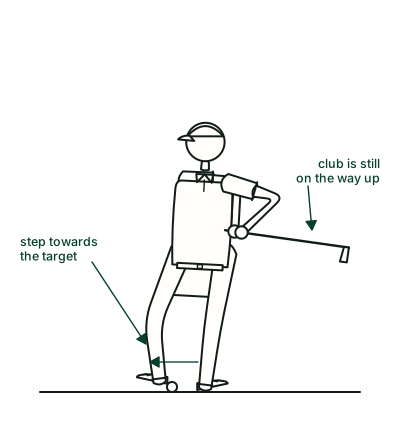
Step 3: Step and hit
As soon as the club passes your back leg, step your front foot towards the target until you reach your normal, wide stance. You hit the ball out of that step.
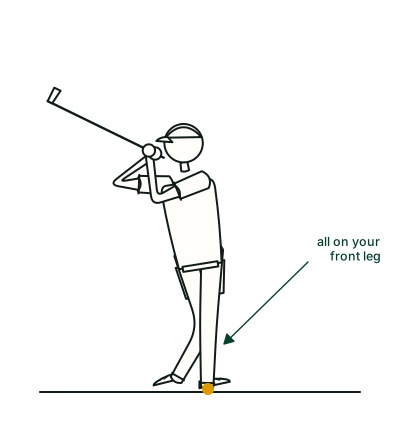
Step 4: Finish on your front leg
Checkpoint: at impact almost all of your weight is on your front foot, and you finish calmly in balance on that leg.
How often
10 practice swings with the step, then 2 sets of 8 shots.
The step makes hanging back almost impossible, but it also disturbs your timing. Short sets stop you from rehearsing the step itself instead of the weight shift.
Safety
Do the first repetitions without a ball, so that you do not step towards the ball off balance.
Sources
- Hanging Back | Swing Characteristics | TPI
- How to Stop Hanging Back in Golf Swing (Drills & Tips), Clint McCormick (HackMotion)
Is this your fault to fix?
Caddium measures it in your own swing video — your first analysis is free.
Start free