

Torso shift
Step switch for the downswing
Forward lunge
Start the downswing from the ground with your lower body, so that your chest and head do not shoot forward towards the target.
Recognise this?
- Your chest and head shoot towards the target in the downswing; on video you are clearly past the ball at impact.
- Very high balls that spin a lot and carry little distance.
- Steep, deep divots.
- Balls that start left, or that curve away to the right if your path also runs from outside to in.
Why it happens
Your upper body shifts too far sideways towards the target in the transition and the downswing. As a guideline: normally your lower body moves about ten centimetres towards the target and your upper body follows with five to eight centimetres; with this fault the upper body goes well past that. The result is a very steep angle of attack and exceptionally high balls with a lot of spin. Physically it comes down to limited hip and ankle mobility, weak glutes and abdominal muscles and too little strength in the lower body: anything that stops your lower body shifting and turning forces your upper body to take over. There are two variants: an early dive, which is a sequence problem because your upper body pulls from the top with the front shoulder, and a late dive, which is a compensation for a scooping release — you move forward to stop the club hitting the ground behind the ball. Note: this works for the early dive (pulling from the top); if you hit mainly fat after this drill, your dive is a compensation for scooping hands — start with the Compression drill instead.
What the drill fixes
The step switch forces the sequence: your downswing starts with a foot step, so your lower body goes before your chest. On video you see straight away whether your head stays in place while your hips do shift.
What you need
- Room to step
- A mid iron
- A camera from the front
advanced
How to do it
Step 1: Make the diagnosis first
Film a normal swing from the front and check whether your chest and head move further towards the target than your pelvis. If they do, you are lunging forward.
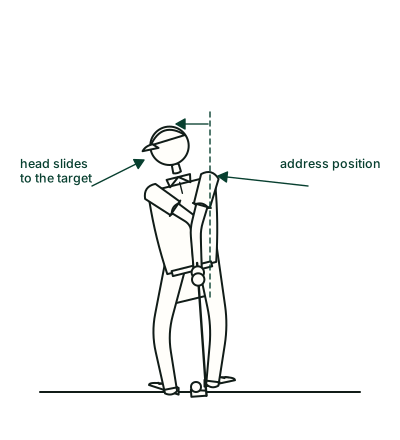
Step 2: Step back on the backswing
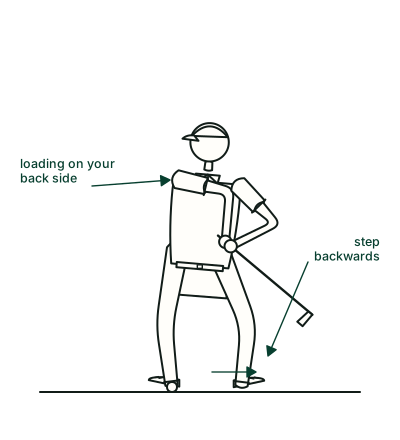
As you start the backswing, take a small step back with your back foot, so that you load clearly onto your back side.
Step 3: Start the downswing with a step towards the target
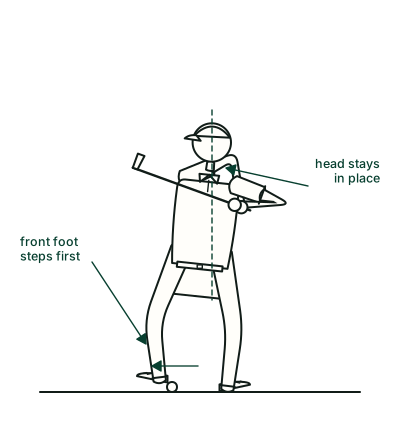
Start the downswing with a decisive step of your front foot towards the target, so with the lower body first. Checkpoint: your chest only starts turning after that step, and your head stays roughly in place.
How often
10 practice swings with the step switch, then 2 sets of 8 shots, with a video check after each set
The video check is the core of it: the source lets the correction depend on what you see on screen, not on what you feel.
Safety
Do the first repetitions without a ball.
Sources
- Forward Lunge | Swing Characteristics | TPI
- Identify and Correct Your Forward Lunge in the Golf Swing, Tyler Ferrell, Golf Smart Academy
Is this your fault to fix?
Caddium measures it in your own swing video — your first analysis is free.
Start free