

Short game
Stick along the ribs
Scooping / flipping
Chip with quiet wrists: let your chest take the club back and forward again, so that your hands do not have to help.
Recognise this?
- You try to help the ball up with your hands and feel your wrists give it an extra flick just before the ball.
- The contact is different every time: one chip comes out clean, the next you hit fat or thin, while you were trying to do the same thing.
- The ball comes off higher and softer than intended and therefore keeps finishing just short.
- You cannot get the distance under control; the same swing keeps producing a different length.
Why it happens
In a good chip the leading wrist (the left one for a right-handed player) stays flat during the backswing, without breaking or hinging. Mike Dickson calls that the dead wrists shot: the hands are active, but the wrists stay still. As soon as there is too much wrist movement in it, unwanted speed creeps in and the contact becomes unpredictable. Dickson links that to the set-up: a narrow stance with the feet under your pelvis, the head over the ball and a neutral shaft with the butt end of the grip pointing at your belt; leaning the shaft strongly towards the target is exactly what takes away loft and bounce. Jon Hearn puts the cause in the engine of the movement: the chest should drive the chip, and if the wrists do the work the movement loses its reference point. Kelley Brooke likewise names too much wrist movement as one of the two main causes of poor chip contact, alongside weight that sinks back.
What the drill fixes
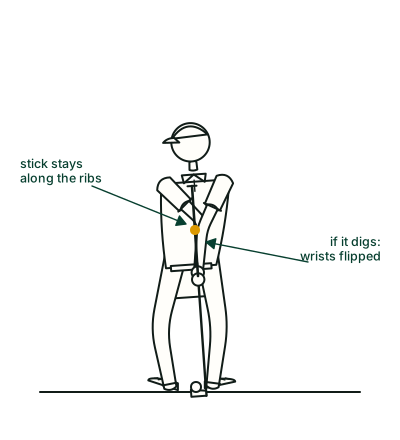
The stick in line with the shaft makes your wrists visible. If they stay still, the stick keeps resting quietly along your ribs; if they flip, the stick immediately digs into your front ribs. You get that feedback on every shot, without video and without anyone watching.
What you need
- Your wedge
- An alignment stick, or a second wedge as a substitute
- A handful of balls
easy
How to do it
Step 1: Take the stick into your grip
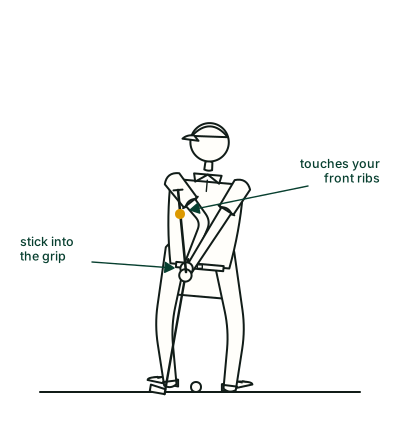
Grip the alignment stick together with your club, so that the stick lies in line with the shaft. Your hands sit slightly ahead of the ball and the stick touches the inside of your ribcage. That contact point is your reference point.
Step 2: Backswing to hip height
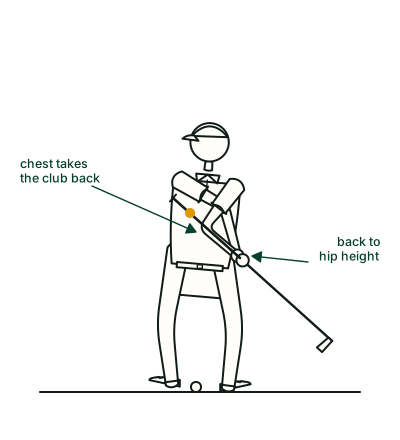
Play chips with a backswing to hip height. Let your chest take the club back. If the stick stays resting quietly along your ribs, your wrists are still.
Step 3: Swing through and feel the stick
Swing through and pay attention to the feedback: if the stick digs into your front ribs, your wrists have flipped after all. Feel that, repeat, until the stick stays quiet on every shot.
Step 4: Take the stick away
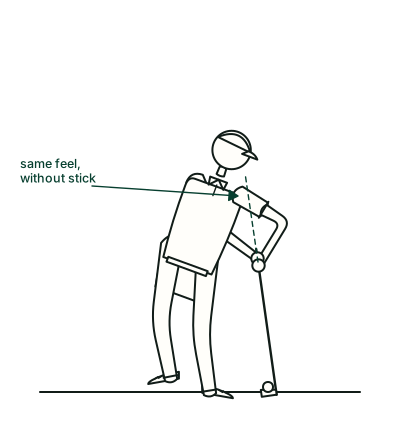
Take the stick away and play the same chips without the aid, with the feel of step 3 still fresh.
How often
About 15 minutes with the stick, then carry on without the stick
Hearn himself gives that build-up. The stick gives immediate feedback on every shot, so you do not need a high number of repetitions; you have done enough once the stick stays quiet for a run of ten chips.
Safety
The stick protrudes well above your hands. Do not swing it at speed in a low space and keep others at a distance.
Sources
- 3 crucial fundamentals for improving your chipping around the greens (Mike Dickson, GOLF Top 100 Teacher)
- This simple drill from Justin Rose's short-game coach fixed my chipping woes (Jon Hearn)
- Here's why you're skulling your chips - and how to stop (Kelley Brooke, LPGA)
Is this your fault to fix?
Caddium measures it in your own swing video — your first analysis is free.
Start free