

Ball position
T-station for ball position
Ball position too far back
Set a fixed, visible ball position for each club and practise switching between them.
Recognise this?
- Balls that start to the right and stay there.
- Thin shots: the ball shoots away low and hard, much lower than you are used to from that club.
- Alternating with tops and fat shots — the contact feels unpredictable.
- With the driver: high, short balls that you hit off the top of the club, often with a mark on the crown.
- The feeling that your hands are a long way ahead of the ball and that you have to chop down steeply on it.
Why it happens
A ball further back encourages a downward strike. With an iron you want that, but if you overdo it, the ball sits so far behind your low point that you strike it while the club is still travelling firmly downwards; a low point ahead of the ball gives a thin shot. Tops, fat shots and misses to the right go with that too. With the driver that same downward strike works directly against you and you get skied drives. The directional fault is the mirror image of a ball too far forward: in the measurement with eleven professionals, shoulders and clubface rotated along with the ball, so if the ball moved away from the target side, the shoulders closed, the face aimed with them, the weight shifted to the back foot and the path at impact became more in-to-out — exactly the combination that sends the ball to the right.
What the drill fixes
The stick at right angles makes your ball position visible and repeatable instead of something you estimate again for every shot, and forces you to move it deliberately when you change club.
What you need
- Two alignment sticks, or two clubs you are allowed to lay on the ground
- Your wedge, a mid-iron and your driver
- Balls
easy
How to do it
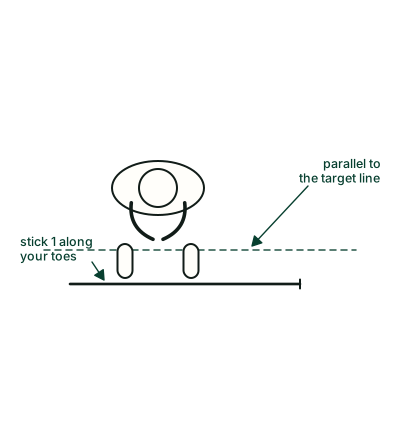
Step 1: Stick 1 along your toes
Lay stick 1 along your toe line, aimed slightly left of the target — so parallel to the target line, not at it.
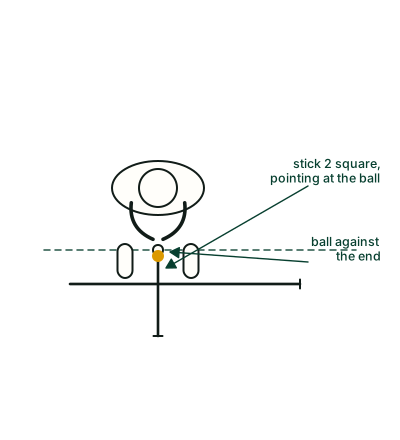
Step 2: Stick 2 across it
Lay stick 2 at right angles across it, pointing at the ball. That stick marks your ball position in the stance and shifts only when you change club.
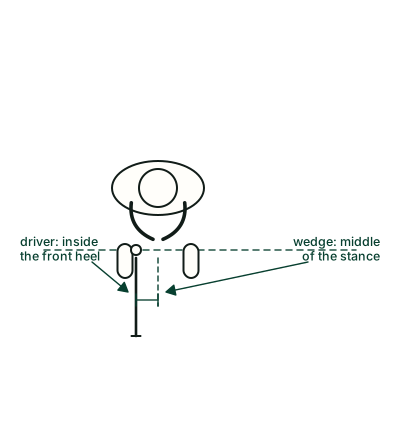
Step 3: Set the stick per club
Wedge in the middle of the stance, mid-iron a fraction ahead of the middle, driver just inside the heel of your front foot. Hit five balls per club and place every ball exactly against stick 2.
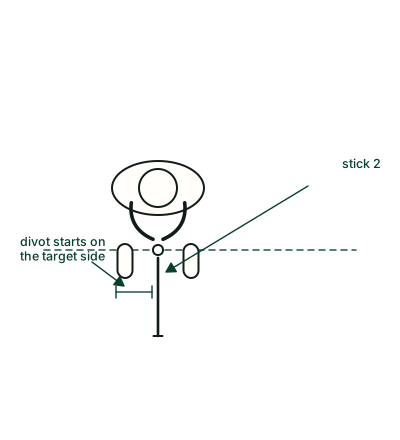
Step 4: Check the divot
Look at the ground in front of the ball after every shot: with the irons the divot should start on the target side of stick 2.
How often
5 balls per club, 3 clubs, 2 rounds
Five balls are enough to learn to feel a ball position without endlessly bashing away with the same club; two rounds make sure you practise the switching of ball position itself, because that switching is the real skill.
Sources
- This was our most-read golf instruction tip of the year (Luke Kerr-Dineen)
- Learn this crucial ball-striking skill and pure your irons like never before (Christy Longfield)
- Perfect Ball Position With Every Club (Katie Dawkins, Golf Monthly Top 50 Coach)
- How to Use Alignment Sticks (Matt Saternus, Plugged In Golf)
- The Proper Golf Stance (Will Shaw, PhD, PGA Pro, Golf Insider)
- Kim e.a. (2018), Biomechanical Effects of Ball Position on Address Position Variables of Elite Golfers, Journal of Sports Science and Medicine 17(4):589-598
Is this your fault to fix?
Caddium measures it in your own swing video — your first analysis is free.
Start free