

Short game
Two lines in the sand
Bladed greenside bunker shot
Put your attention on the sand instead of on the ball: take a strip of sand of about fifteen centimetres, with the ball in it.
Recognise this?
- The ball shoots low and hard out of the bunker and flies over the green, sometimes into the bunker or the water on the far side.
- You hear a hard click instead of a dull thud; hardly any sand comes out with it.
- You unconsciously aim at the ball instead of at the sand beneath it.
- You decelerate just before the ball, afraid of hitting it much too far.
Why it happens
A greenside bunker shot should not be ball contact: the club goes into the sand first and the ball comes out on the sand you displace. Kellie Stenzel describes the goal as a fairly long sand divot with the ball somewhere in that divot; the bounce of the wedge lets the club slide through the sand instead of digging. She names two setup faults that ruin the sand contact: a shaft that leans towards the target at address, which jams the leading edge of the club into the sand and costs you speed, and a closed clubface, which only increases the digging; the face should be square to slightly open. Ball position counts too: further forward in the stance makes the club meet the sand earlier than the ball by itself. She attributes the thin, bladed bunker shot to the habit of leaning back and scooping the ball up instead of simply swinging through. Speed comes on top of that: Trillium Rose points out that sand slows the clubhead down far more than grass does, with the rule of thumb that from 30 metres you swing as if it were 60 metres. Tom Stickney puts the heart of it in attention: recreational players are too ball-focused, while the sand contact point is the actual task.
What the drill fixes
The two lines make the sand contact measurable and take your attention away from the ball. After every swing you see exactly where the club entered the sand and where it came out: if the back line is still there, you went too far forward into the sand; if the front line is still there, you decelerated.
What you need
- A practice bunker
- Your sand wedge or lob wedge
- A rake
medium
How to do it
Step 1: Draw two lines in the sand
Draw two lines in the sand with the heel of your club, about 15 centimetres apart, at right angles to your target line. Dig your feet in so that the sand comes up to the soles of your shoes. You start without a ball.
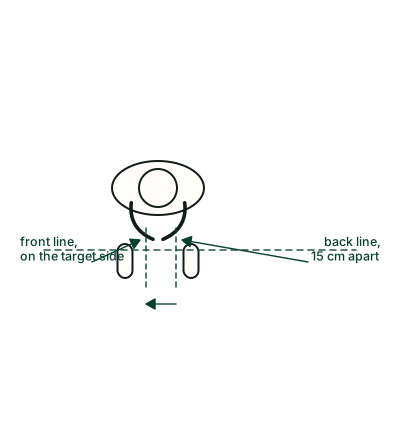
Step 2: Swing through the strip of sand
Set up without a ball, with the clubface square to slightly open and the shaft not leaning towards the target. Swing through the sand between the two lines and take that whole strip with you.
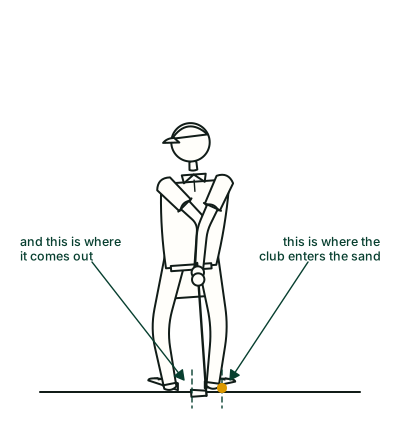
Step 3: Check whether both lines are gone
If both have been wiped out, your sand contact is right. If the back line is still there, you went too far forward into the sand; if the front one is still there, you decelerated.
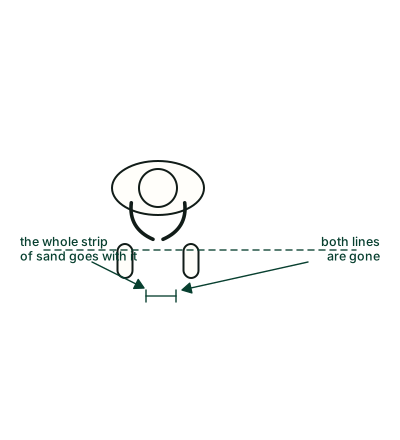
Step 4: Only now put a ball between the lines
Put the ball between the two lines, slightly forward in your stance, and repeat the same movement with the same full throughswing.
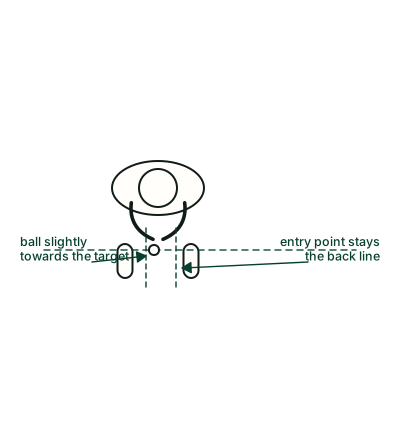
How often
First ten swings without a ball, then ten with a ball, and redraw the lines after every swing
Starting without a ball is the heart of the drill: it takes your attention away from the ball, exactly the fault Stickney describes. Really redraw the lines every time; without fresh lines you lose the feedback and you are no longer practising anything. The numbers are a practical choice by the researcher.
Safety
Rake the bunker neatly afterwards, and only practise in a bunker that is meant for it.
Sources
- 10 ways to simplify greenside bunker shots (Kellie Stenzel, GOLF Top 100 Teacher)
- 10 ways to guarantee you get out of a greenside bunker (Kellie Stenzel, GOLF Top 100 Teacher)
- This can't-miss bunker drill will give you a lift from the sand (Tom Stickney)
- This 1 issue is killing your greenside bunker shots, says top teacher (Trillium Rose, GOLF Top 100 Teacher)
Is this your fault to fix?
Caddium measures it in your own swing video — your first analysis is free.
Start free